Showing posts with label research. Show all posts

Friday, 14 March 2014

Audience Research


We briefed our primary audience of teenage boys about our ideas for our film. Overall they really liked our idea, however they thought that the idea was quite unrealistic and unsure if it would actually be believable. We also found out that our target audience preference of film genre is mostly comedy and action, we were satisfied by that result as our film is an action film. Most of our audience said that they would go to watch our film in the cinema This audience research has been very helpful for us as it has made us understand our target audience more. Our secondary target audience is women aged 14- 30.

Thursday, 13 March 2014

Genre Research


Genre Research- Action and Superhero Films

Characters-
Main Hero

  • Sometimes mythical creatures
  • Big sense of morality and courage
  • Do what is good and right 
  • Sacrifice themselves for humanity 
  • Often behind disguises, are shy and geeky

Villain
  • The audience love to hate and hate to love 
  • Selfish and want power 
  • Either the first scene consists of the Villain or the Villain comes later in the film this depends on how familar the audience are with the film and whether it is a sequel
Lover Of Hero

  • Helpless and naive
  • Often introduced later in the film

Typical scenes of genre-

  • Superhero films would either start with the bad guy or start with showing us how the superhero got his powers.
  • Action films always include a chase scene

Typical Iconography- 

  • Weapons
  • Superhero suits

Typical Themes-

  • Good vs Evil 
  • Immorality 
  • Morality 
  • Superhuman 

Sunday, 2 March 2014

credit title sequence research


In this opening sequence the credits are randomly placed on the framing. The colour is white this makes the names stand out against the black. The font is written in capital letters to make it readable to the audience and accessible to read while watching the different shots.  The frames and change of shots are fast and sharp, it shows the genre idea of action. It keeps the audience's attention. the title is bold and in capital letters to give audience title knowledge.

Order of credits:

  1. Production company
  2. Director
  3. Actors
  4. Further people who help with production
  5. Castings
  6. Costume Designer
  7. Co producers
  8. Sound design
  9. Music
  10. Editors
  11. Production Designer
  12. Director of photography
  13. Executive producers
  14. Producers
  15. Book it is based on (book credits)
  16. Screenplay
  17. Director

order of credits in film industry


1. Distribution Company
2. Name of production company

3. Director
4. Producer
5. List of actors
6. Movie title 
7. Editor
8. Costume designer

Monday, 9 December 2013

Research on open sequences


In this opening sequence the first thing we are made to focused on is the daughter as it shows clips of her from when she was young this shows us that the story may be focused around her then it goes onto also focus the dad so its easy to tell who the main characters are and what the story is going to be about. The credits are all put into the opening but this time are not as bold. However It only shows the main characters name "liam neeson" and the production companies because of it only showing one actors name we immediately know that the film is going to be based around him and the other actors name didn't appear we are made to think that they are less relevant. 


In this opening sequence we are first shown the production companies this is a big part of the opening sequence and of the film itself. The opening sequence has music in the background to show the genre, this music gives a feel that the film is going to be explosive. we then get to know and think that the film is an action film. The credits are bold and well noticeable and quick with no other main distractions to fit in with the style of the film, we are then shown batman's mask this tells us who the story is based on.


This is the opening sequence for step up 3, the first thing we see is the title if the film this immediately  tells the viewers what they are watching/what the film is called. The music and the set up of the opening gives us information of the genre of the film as it is all high beat hip hop music with street dance we begin to think that it is a film set in 2013. The bright and vibrant colours used suggest that the film is going to be very lively and bright. However in this opening there is now credits this means that the viewers may have no clue who is in the film.

Wednesday, 11 September 2013

Aerial Shot


An exciting variation of a crane shot, usually taken from a helicopter. This is often used at the beginning of a film, in order to establish setting and movement.

tilt


A movement which scans a scene vertically, otherwise similar to a pan.

pan


A movement which scans a scene horizontally. The camera is placed on a tripod, which operates as a stationary axis point as the camera is turned, often to follow a moving object which is kept in the middle of the frame.
example:
 

Extreme close up:


Camera angle:  Extreme Close Up  
The extreme version of the close up, generally magnifying beyond what the human eye would experience in reality. An extreme close-up of a face, for instance, would show only the mouth or eyes, with no background detail whatsoever. This is a very artificial shot, and can be used for dramatic effect.

close up:


Camera angle: close up  
This shows very little background, and concentrates on either a face, or a specific detail of mise en scène. Everything else is just a blur in the background. This shot magnifies the object and shows the importance of things. The close-up takes us into the mind of a character. In reality, we only let people that we really trust get that close to our face - mothers, children and lovers, usually - so a close up of a face is a very intimate shot. A film-maker may use this to make us feel extra comfortable or extremely uncomfortable about a character.

Medium shot:


Camera angle:  Medium shot
Contains a figure from the knees/waist up and is normally used for dialogue scenes, or to show some detail of action.

Long Shot:


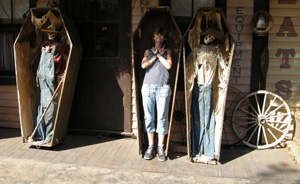
Camera angle: Long shot


long shot shows the image as approximately "life" size ie corresponding to the real distance between the audience and the screen in a cinema (the figure of a man would appear as six feet tall).FULL SHOT showing the entire human body, with the head near the top of the frame and the feet near the bottom. While the focus is on characters, plenty of background detail still emerges: we can tell the coffins on the right are in a Western-style setting, for instance.

Extreme long shot:


Camera angle: Extreme Long Shot

 This can be taken from as much as a quarter of a mile away, and is generally used as a scene-setting, establishing shot. It normally shows an ecterior, eg the outside of a building, or a landscape, and is often used to show scenes of thrilling action eg in a war film or disaster movie. There will be very little detail visible in the shot, it's meant to give a general impression rather than specific information.
The extreme long shot on the left is taken from a distance, but denotes a precise location - it might even connote all of the entertainment industry if used as the opening shot in a news story.